
 By
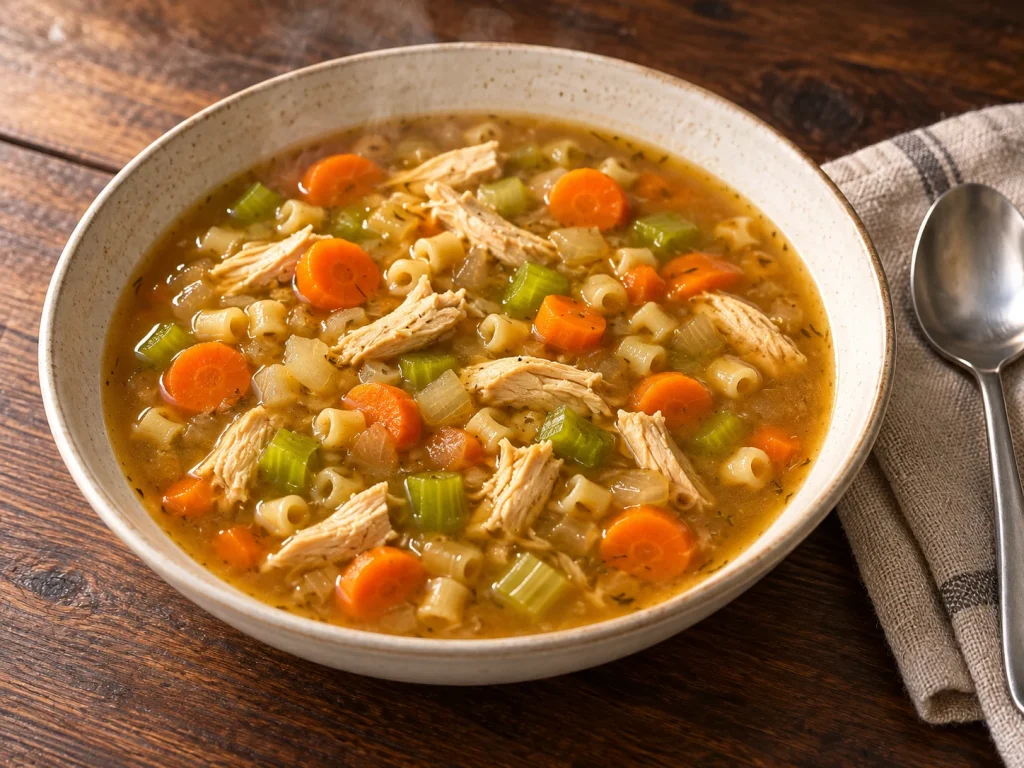
Rosemary, thyme and sage make this a fragrant chicken soup; a squeeze of lemon keeps the bowl from feeling heavy. The chicken gets just a little golden color before finishing gently in the broth. Ditalini cooks in that same Dutch oven, so its starch gives the soup a fuller body as well as saving a pot.
Build the soup in one Dutch oven
A light sear gives the chicken a little golden color, not a hard crust. Set it aside while the vegetables soften, then use the broth to scrape up the browned bits. Return the chicken for a gentle simmer and check that the thickest part reaches 165°F before moving it to a fresh clean plate. Chop or shred it while the ditalini cooks, then return it once the pasta is tender. Everything happens in the same Dutch oven.
Let the ditalini thicken the broth
The starting quantities are still eight cups of broth and one cup of dry ditalini. With the cooked chicken temporarily out of the pot, stir the dry pasta into the simmering soup. Follow the package time as a guide, but taste a piece before calling it done. Small splashes of broth or water will loosen the soup if the pasta takes up too much liquid.
Dried herbs and the lemon finish
Finely crushed rosemary is much nicer in a spoonful of soup than woody needles. Choose half a teaspoon ground sage or one teaspoon rubbed sage, not both. Add the finishing half-teaspoon of thyme with the pasta and save the lemon for the end. Taste again if extra broth or water has diluted the seasoning.
The noodles keep drinking
The broth gets fuller as the pasta releases starch, and the noodles keep absorbing liquid after the heat is off. Expect softer noodles in leftovers and add broth or water when reheating. That is the trade-off for cooking everything in one pot. Cool the soup promptly in shallow containers and follow the USDA guidance in the cooking notes.
Why there is no overall time
The old total was for a method that cooked the pasta separately. This one-pot adaptation has no overall time until one can be established by cooking it. For now, follow the vegetable-softening cues, check the chicken with a thermometer and use the pasta package as a guide.
Adapted from The Defined Dish’s Herbed Chicken Noodle Soup, using dried herbs, chicken breasts and extra garlic. This site version cooks the dry ditalini in the same Dutch oven as the chicken; the revised method has not been kitchen-tested. Read or watch the source.
Herb Your Enthusiasm — One-pot chicken and ditalini soup
Ingredients
Method
- Give the chicken a light sear. Pat the chicken breasts dry with paper towels; do not rinse them. Season with ¼ teaspoon of the initial salt. Heat 1 tablespoon of the olive oil in a 6-quart Dutch oven over medium-high heat. Add the breasts in a single layer and sear until lightly golden, roughly 2 to 3 minutes per side. Aim for a little color, not a dark crust or fully cooked chicken. Transfer to a plate reserved for the partially cooked chicken. Lower the heat if the browned bits threaten to scorch; keep those bits in the Dutch oven for the broth.
- Build the vegetable base in the Dutch oven. Reduce the heat to medium and add the remaining 1 tablespoon olive oil to the same Dutch oven. Add carrots, celery, onion, the remaining ¼ teaspoon initial salt and the black pepper. Cook for 8 to 10 minutes, stirring, until the onion softens. If the browned bits are darkening too quickly, add a small splash from the measured broth and scrape the bottom. Add the garlic and cook for 30 to 60 seconds.
- Add the dried herbs. Stir in the first teaspoon of thyme, finely crushed rosemary, sage, bay leaves, turmeric, ginger and paprika. Cook for 30 seconds without scorching.
- Finish cooking the chicken in the broth. Pour the broth into the Dutch oven, using the remainder of the measured 8 cups if a splash went in with the vegetables. Scrape up the golden browned bits with a wooden spoon and bring to a gentle simmer. Return the lightly seared breasts and their plate juices. Keep the broth gently simmering, not boiling hard, until the thickest part of each breast reaches 165°F on a food thermometer; start checking around 10 minutes and allow longer for thick breasts. Transfer cooked breasts to a fresh clean plate, then chop or shred them. Do not reuse the plate that held partially cooked chicken unless it has been washed.
- Simmer the dry pasta in the soup. With the cooked chicken temporarily out of the pot, bring the broth to a steady simmer. Stir the 1 cup dry ditalini and remaining ½ teaspoon thyme directly into the Dutch oven. Cook uncovered, stirring regularly so the pasta does not stick, until the ditalini is tender and the vegetables are tender to your liking. Use the pasta package timing as a starting point and taste a piece to check. Add extra broth or water in small splashes if absorption or evaporation leaves too little liquid; do not boil the pasta in a separate pot.
- Return the chicken. Stir the chopped or shredded cooked chicken and its resting juices back into the Dutch oven. Heat through gently. The pasta starch will give the broth more body than separately cooked noodles would; loosen with additional broth or water if needed.
- Finish with lemon. Remove the bay leaves. Stir in the 2 tablespoons lemon juice, then taste and adjust salt and pepper. Add more lemon only if you want a brighter finish. If adding more broth or water has diluted the seasoning, taste again before serving.
- Serve and handle leftovers. Ladle the chicken, pasta and broth from the same pot into bowls. The pasta will keep absorbing liquid as the soup stands. Refrigerate leftovers promptly in shallow containers following the USDA guidance linked below. Add broth or water when reheating to restore a spoonable consistency, bring the soup to a rolling boil and verify it reaches 165°F.
Notes
Estimated nutrition
Per serving, when the recipe is divided into 4 equal portions of the soup. These are ingredient-based estimates, not lab results.
- Calories
- 460 kcal
- Protein
- 41.2 g
- Carbs
- 45.5 g
- Fat
- 13.5 g
- Fiber
- 5.2 g
- Saturated fat
- 2.6 g
Brands, portion sizes and optional additions can change these numbers. Sodium is not shown because the salt or packaged seasoning amount cannot be estimated reliably.
What the estimate includes
- Includes the chicken, vegetables, measured oil and dry pasta, divided into 4 bowls.
- Uses 1¾ cups onion, the midpoint of the listed range, and ground sage rather than rubbed sage.
- Dry ditalini uses a generic dry-pasta profile and a 122 g cup estimate; weighing your pasta will improve accuracy.
- Uses generic low-sodium broth. Any extra thinning liquid is assumed to be water.
- Not included: 2 bay leaves. Bay leaves removed before serving; infusate not quantified.
- Not included: ½ teaspoon kosher salt to start, divided between the chicken and vegetables, plus more to taste. Kosher salt density/brand and extra salt to taste unknown; sodium not supported.
Calculated from USDA FoodData Central, SR Legacy ingredient data. Individual food matches: Lemon juice, raw; Garlic, raw; Pasta, dry, enriched; Celery, raw; Onions, raw; Carrots, raw; Spices, ginger, ground; Spices, pepper, black; Spices, sage, ground; Spices, thyme, dried; Chicken, broiler or fryers, breast, skinless, boneless, meat only, raw; Spices, paprika; Spices, rosemary, dried; Oil, olive, salad or cooking; Soup, chicken broth, low sodium, canned; Spices, turmeric, ground.
Another bowl for another day
The ramen below keeps the broth at the center of the meal; the beef-and-barley stew takes a slower, heartier route.
For safe cooling and reheating, see the cooking notes. There are more dinners in weeknight dinners or the comfort-food collection.